Patrick Lencioni’s book The Ideal Team Player listed 3 essential virtues for a team player. Lacking in any of them will make an employee not a team player and will harm the motivation and effectiveness of the team. The 3 virtues are humility, hunger and smarts.
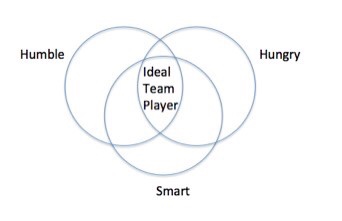
Humility: Asking each person to be humble might be a high standard. But a team member cannot have strong ego. Otherwise the team may not function well when such a person exists in the team. Such a person may always wants to take credit or show off in front of other people. It would be pretty annoying and make other people feel bad. Also, such a person could be barely teachable. They will endlessly try to defend themselves and find arguments for what they did, even for some minute things. Team discussion sometimes ends in rabbit holes. In a simple word, these people with strong egos always have to be right. Or even what they say has a slight slice of rightness in it, they would spend team’s precious time just to prove that slice of rightness, disregarding what was the objective of the original discussion and what team try to achieve.
Hunger: The team player with the hunger will always look for more to do, more to learn and more responsibilities. They are self motivated and self driven. They want to do more and care about the team’s goal. On the opposite side, a team player that lacks hunger is reluctant to learn. They often says they cannot take a certain task. They also don’t see work. They may avoid trying to spend more efforts on their own to try to figure out things but constantly or readily ask help from other team members and stay not able to work independently.
Smarts: This refers to whether a person has common sense, business sense and understanding, and professionalism. It is not like that everything will be in written format in a work agreement. Whether an employee has the sense of how to behave in a business world, how to interact with colleagues, or what type of work ethics they have or lacking. Whether the person behaves professionally in their work conducts, etc.
Ideally, the hiring process eliminates anyone that is lacking in these virtues. But it is not easy during short interviews to identify what type of employees the candidates would be.
No one is perfect. The persons have all 3 virtues are the natural leaders. The people strongly lacking in one or two of the virtues could be reminded. Anyone that is a mature person and cares about the job can improve and grow on these virtues. But for a team member somehow does not get on board with the rest of the team from time to time, it may be time for the hard decision.
The decision to let a person go would be hard, one is because that team member stayed with team long. Whether they are likable or not, they have been part of the team. Letting them go, would that make rest of the team happy or would that hurt other team member’s feeling? It is hard to tell. But probably a mixed feeling since that is a person not functioning well within the team. It might be a likable person but not capable to do the work, not hungry enough to learn and improve enough. Then after-all other team members have to do more to cover this team member’s work. And that is not fair.
The other part that is hard for the decision is that these people already have certain training and experience about the job they do. It is like sunk cost in economist’s term. Since we already invested in them, it is hard to let go. Any new employee will need to go through training again and pick up knowledge gradually. It is another bet with new employee because we don’t know how they will turn out to be.

 Digital Transformation Journey